- Jeju Provincial Council, Jeju Province, Civil Society, and Industry Convene to Formulate Joint Solutions
- Broad Consensus Calls for Prompt Action Amid High Feasibility for RE100
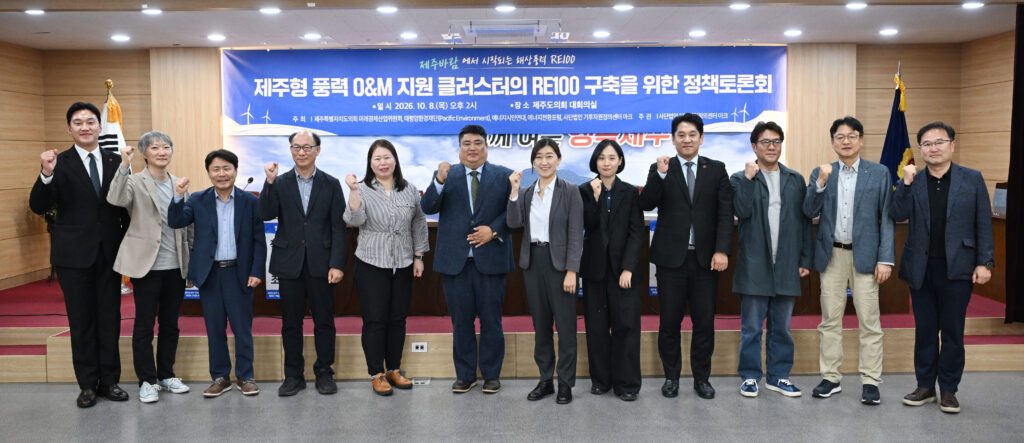
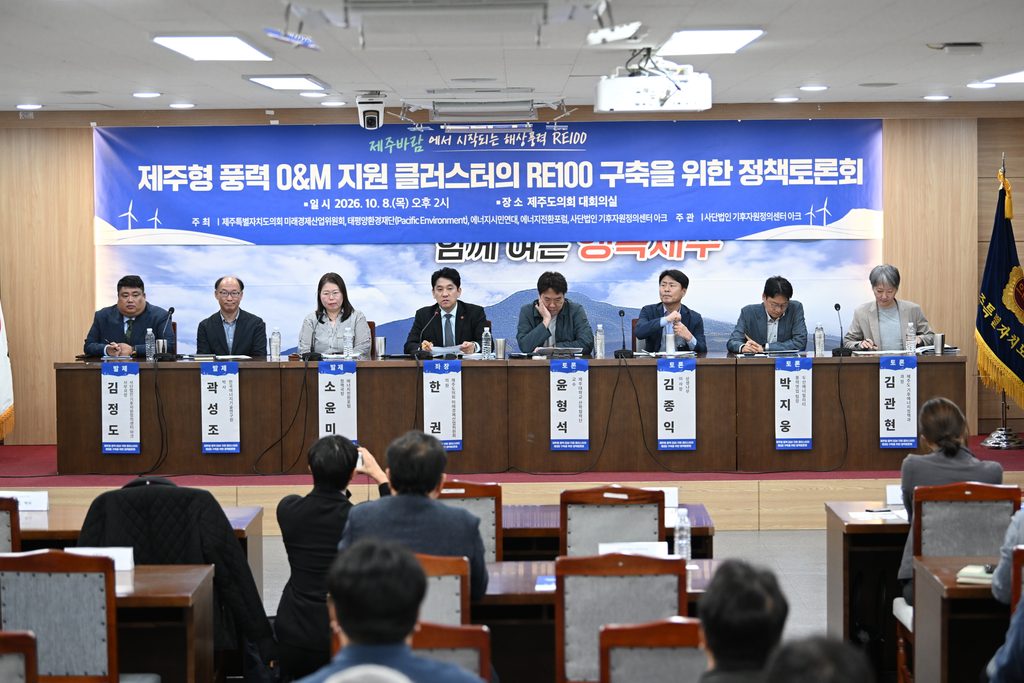
On October 8 at 2:00 PM, the Future Economy and Industry Committee of the Jeju Provincial Council, the Alliance for Resource & Climate Justice Center, Pacific Environment, the Energy Transition Forum Korea, and the Korea NGO’s Energy Network held a policy forum in the Main Conference Room of the Jeju Provincial Council to propose establishing the “Jeju-Style Wind Power O&M (Operation & Maintenance) Support Cluster”—a key pledge of the Jeju Provincial Administration—under an RE100 framework.
The forum was organized to explore pathways through which offshore wind power can catalyze regional RE100 initiatives and lead to the development of fully decarbonized RE100 ports, centered on powering the planned Jeju-Style Wind Power O&M Support Cluster (which will house an offshore wind O&M center and spare-parts hub) entirely with renewable energy. Through this, participants underscored the necessity of an offshore wind industrial model tailored uniquely to Jeju, where offshore wind power directly connects with related industries and industrial complexes to expand into a robust regional offshore wind industrial ecosystem.
The presentation session began with a briefing by Soh Yoon-mie, Policy Director at the Energy Transition Forum Korea, on “Domestic and International Trends and Case Studies on Advancing RE100 in Ports and Port Facilities,” followed by Dr. Kwak Sung-Jo of the Korea Institute of Energy Research (KIER) on “Overseas O&M Port Cases and Domestic Offshore Wind Support Ports.” Lastly, Kim Jung-Do, Director of the Alliance for Resource & Climate Justice Center, presented on “Strategies for Linking the 9th Popularly Elected Jeju Administration’s Pledges to Build a Jeju-Style RE100 Offshore Wind O&M Support Cluster.”
First, Policy Director Soh Yoon-mie of the Energy Transition Forum Korea diagnosed that Jeju’s ports must be strategically designed as key renewable energy demand centers and grid flexibility hubs. She noted that Jeju requires storage and demand resources to absorb surplus power resulting from frequent output curtailment, while simultaneously emerging as a new center of electricity demand due to an increasing number of large international vessels making port calls. In contrast, domestic ports currently suffer from low utilization rates relative to their Alternative Maritime Power (AMP) facilities, grid saturation, constraints on direct Power Purchase Agreements (PPAs), burdensome grid usage fees, and misalignments between investing and benefiting entities, which prevent electrification from being integrated into a unified power system.
As international benchmarks, she introduced the cases of Valencia, which is pursuing energy self-sufficiency by 2035 through the integration of renewable energy generation and port electrification; Barcelona, which treated cruise ship electrification as a massive new demand source and built a dedicated port grid of approximately 80 MW; and Rotterdam, which resolved grid congestion through flexible demand, ESS, and capacity sharing among enterprises instead of expanding transmission lines. Citing these overseas examples, Director So proposed transforming Jeju’s ports from mere electricity consumers into strategic bases that flexibly adjust power consumption according to conditions and actively help stabilize the power grid.
To achieve this, she suggested establishing systematic management by integrating direct PPAs, utility-scale Energy Storage Systems (ESS), Demand Response (DR), and Virtual Power Plants (VPP). When renewable generation yields surplus power, it can be stored in ESS or consumed intensively by electric vessels and port equipment to mitigate output curtailment; conversely, during peak electricity demand hours, stored electricity can be discharged and charging deferred, relieving strain on the power grid.
As an implementation strategy, she presented a three-stage roadmap:
- Designing the complex where offshore wind O&M facilities will concentrate to be powered by renewable energy from its initial design phase in 2027;
- Expanding this between 2028 and 2030 to electric vessels, shore power for large ships, port machinery, and logistics warehouses to operate the entire port on renewable energy;
- Progressing by around 2030 to a stage where the port contributes directly to the stability of Jeju’s entire power grid through flexible power demand management.
Next, Dr. Kwak Sung-Jo of the Korea Institute of Energy Research (KIER) explained that domestic offshore wind support port infrastructure is critically lacking compared to the deployment pace of offshore wind power, and stated that establishing an O&M base within existing ports is the appropriate direction for Jeju rather than developing staging and assembly support ports. Offshore wind ports are categorized into manufacturer ports for equipment fabrication, staging/support ports for marshalling and assembling components before transporting them to sites, and maintenance (O&M) ports for managing and maintaining wind farms after installation. Dr. Kwak pointed out that Mokpo New Port is currently the only domestic port capable of handling heavy turbines, while installation and service vessels remain scarce and dependent on overseas procurement.
These constraints apply equally to Jeju. An offshore wind staging port requires high ground-bearing capacity to withstand heavy equipment loads, unobstructed navigational channels, an open yard of at least 170,000 m², and at least two berths. Jeju lacks ports that meet these conditions, making it difficult to construct staging ports and leaving a clear limitation: turbines must be assembled and shipped from mainland ports for construction. Accordingly, he advised that Jeju Province should concentrate on O&M infrastructure.
Dr. Kwak stressed the paramount importance of O&M ports, noting that approximately 38% of offshore wind operating costs are devoted to maintenance. Because standardized national inventory management systems for the 200 to 300 types of spare parts required per wind farm are currently lacking, he emphasized that Jeju should proactively establish a shared system pooling vessels, equipment, and port infrastructure. Furthermore, securing harbor facilities capable of accommodating Crew Transfer Vessels (CTV) and Service Operation Vessels (SOV) is imperative. Rather than responding reactively after wind farm construction begins, sites and designs must be preemptively secured through advance surveys of regional demand and location suitability.
The final speaker, Kim Jung-Do , Director of the Alliance for Resource & Climate Justice Center (ARC Center), emphasized that Jeju has already entered a phase where it must consider flexibility resources and strategic demand centers beyond simply expanding renewable energy supply. He stressed that the Jeju-Style Wind Power O&M Support Cluster, pursued as a key provincial pledge, must also align coherently with this policy backdrop. In particular, he assessed that the cluster has the character of a small-to-medium industrial complex, encompassing equipment diagnostics, inspections, maintenance, parts performance evaluations and certifications, servicing, tracking and integrated control, collaborative support, and spare-parts storage and logistics.
Director Kim explained that policy foundations are already in place for the cluster to be developed as an RE100 model, aligning with Jeju Province’s industrial complex RE100 transition and green industry policies. Therefore, the project must be advanced with RE100 in mind starting from the master planning phase in 2027, which will allow Jeju to lead the O&M port model and establish national standards. Furthermore, he presented the potential for local economic revitalization and job creation through integration with the wind industry ecosystem, reiterating that building the wind power O&M support cluster under an RE100 framework is essential to drive long-term RE100 expansion across the entire port and maritime industry.
Following the presentations, a comprehensive panel discussion was moderated by Council Member Kwon Han of the Future Economy and Industry Committee of the Jeju Provincial Council. The panel featured:
- Yoon Hyung-seok, Industry-Academic Cooperation Professor at Jeju National University
- Kim Jong-ik, Chairman of Research Institute WinWinTree
- Park Ji-woong, Wind Power Sales Team Leader at Doosan Enerbility
- Kim Kwan-hyun, Director of the Climate and Energy Policy Division, Jeju Province
The panelists conducted an in-depth discussion on the necessity and immediate tasks of establishing an RE100 model for the Jeju-Style Wind Power O&M Cluster.
First, Professor Yoon Hyung-seok of Jeju National University pointed out that although AMP regulations and facilities have already been established in Jeju, their utilization remains low due to vessels lacking onboard power-reception equipment and high electricity tariffs. He recommended resolving factors hindering existing facility use before expanding new infrastructure. Given port conditions in Jeju, specializing in O&M functions is more realistic than large-scale assembly and installation. He stressed that tenant companies, installed equipment and functions, infrastructure scale, and electricity consumption patterns must be specified first to enable an effective RE100 design.
Addressing the policy fragmentation between energy and maritime affairs/port departments, he called for an active role from maritime and port authorities to incorporate Jeju Port’s O&M functions into the National Port Master Plan in order to secure national subsidies. He further proposed advancing short-term foundational tasks step-by-step prior to large infrastructure construction, such as small-scale AMP-ESS pilot demonstrations, building a port-centered distributed energy special zone model, and accumulating hourly and seasonal port energy data.
Chairman Kim Jong-ik of Research Institute WinWinTree expressed agreement with the port RE100 vision, but cautioned that given the administrative realities of long-term port planning, the proposed transition timeline could be somewhat tight. He noted that realistic transition plans must be derived after rigorous examination of physical requirements such as ground-bearing capacity. In addition, supply policies and demand policies must be precisely coordinated to resolve the mismatch between renewable generation hours and industrial electricity demand hours, and regional universities and civil society must urgently prepare to train specialized professionals.
He emphasized the need to build a foundation capable of stably maintaining and operating facilities even after installation contractors demobilize, noting that port policies and industrial policies must integrate organically for this to become an established anchor industry. He added that while national port decarbonization policies are concentrated on the four major ports, specialized transition strategies are essential for regional ports like Jeju and Mokpo, suggesting that establishing a “Green Shipping Corridor” linking Jeju Port and Mokpo Port could give concrete shape to these discussions.
Representing industry, Team Leader Park Ji-woong of Doosan Enerbility evaluated that, considering Jeju’s circumstances, constructing an O&M port based on wind farms already in operation is more suitable than developing a large manufacturing and staging port. Because O&M is a pivotal pillar determining offshore wind project feasibility and grid stability, he emphasized that equipment, parts, personnel, port logistics, and safety management systems must be integrated as a unified system.
Noting that O&M functions are split between field operations and data/design operations, he explained the need for thorough discussions on establishing field equipment and vessel operating systems, designing a data hub for real-time monitoring, preventive diagnostics, and operational optimization, as well as building cooperation models with existing operators. Finally, he stated that the cluster’s RE100 model must be materialized on the basis of policy support and cooperative frameworks between enterprises and local government.
Lastly, Director Kim Kwan-hyun of the Jeju Provincial Government’s Climate and Energy Policy Division stressed that climate policy should be pursued through the lens of a “climate economy” that generates a virtuous cycle of quality jobs, corporate revenue, and local economic benefits. He underscored that the O&M cluster must be accumulated as a sustainable local industrial asset beyond mere electricity sales and profit sharing. He noted that this will form the foundation for maximizing benefits to provincial residents during the process of deploying 5 GW of offshore wind by 2035.
Furthermore, as an O&M port represents the realistic alternative for Jeju over turbine manufacturing and staging ports, he presented a plan for phased expansion building on the functional enlargement of existing ports and the experience and workforce accumulated through Hallim Port. He announced plans to launch surveys on port ground-bearing capacity and site suitability in close consultation with the port administrative department to reflect these plans in the 5th National Port Master Plan. In closing, he emphasized that supplying renewable energy to the wind maintenance base is a natural policy imperative, and that the province will carefully review realistic conditions and incorporate the forum’s proposals into the 4th Jeju Comprehensive Wind Power Management Plan.
Serving as moderator, Council Member Han Kwon of the Future Economy and Industry Committee stated: “As the standing committee overseeing new and renewable energy industries including offshore wind, the Future Economy and Industry Committee is examining ways to foster the Jeju-Style Wind Power O&M Cluster from diverse angles. As the provincial administration’s pledge implementation plan has taken shape, active discussions on practical institutionalization must continue following today’s debate.” He concluded the forum by adding: “We will continue to broaden public discussion platforms where parliament, administration, industry, and civil society pool their wisdom to realize an RE100-powered wind O&M cluster.”