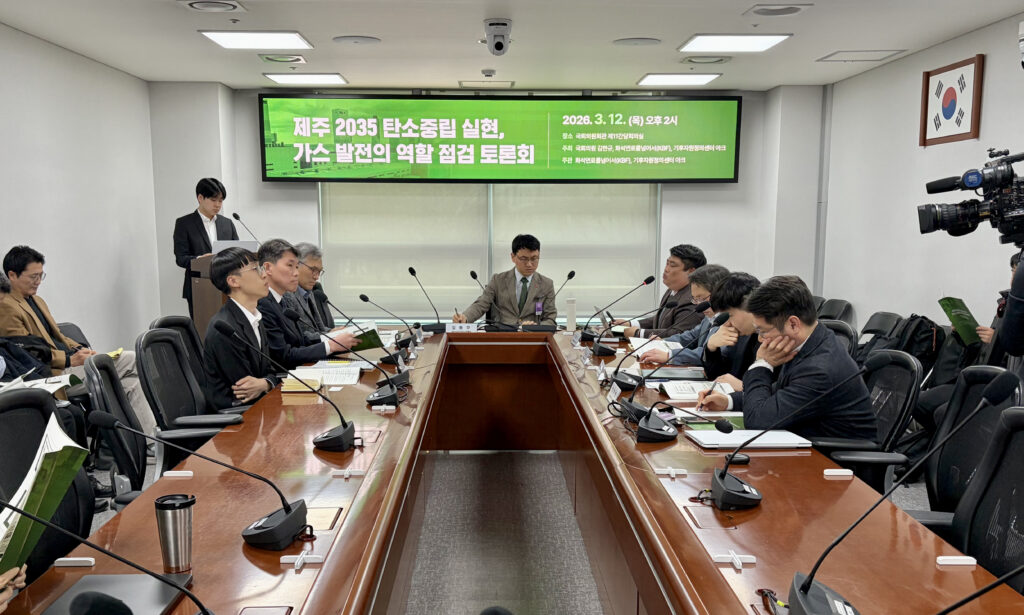
National Assembly Forum Examines the Role of LNG in Jeju’s Green Future
Debate over the 300MW new gas power plant: Necessity vs. Over-investment
Discussion on technical alternatives: Synchronous Condensers, BESS, and Grid-forming technology
On March 12, a forum titled “Achieving Jeju 2035 Net-Zero: Reviewing the Role of Gas Power” was held at the National Assembly. Co-hosted by the Office of Representative Kim Han-kyu, Korea Beyond Fossil Fuels (KBF), and the Alliance for Resource & Climate Justice Center (ARC Center), the event aimed to address the controversy surrounding Jeju’s plan to build a new 300MW LNG power plant and to seek rational energy alternatives.
The forum concluded with a consensus that while grid stability is crucial, a 300MW plant is an excessive addition. Experts urged the continued expansion of renewables alongside flexibility resources like Battery Energy Storage Systems (BESS).
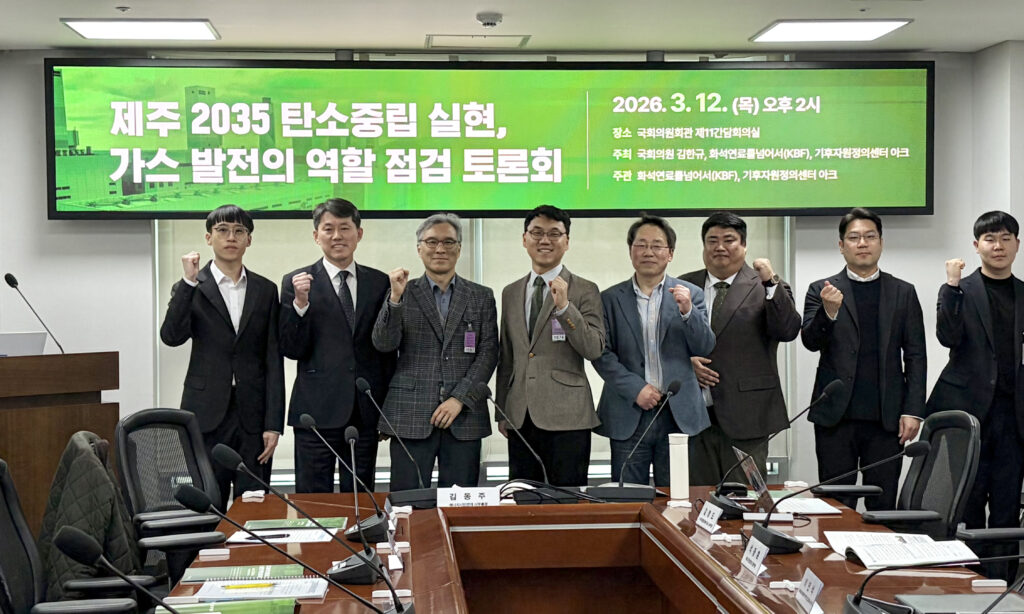
ARC Center: “A Barrier to Net-Zero… Urgent Need for Re-evaluation”
Kim Jung-do, Director of the ARC Center, argued that the 300MW plant contradicts Jeju’s carbon neutrality goals.
He criticized the plan, noting that it would emit up to 1.1 million tons of CO2eq annually—equivalent to 25% of Jeju’s total 2021 emissions—rendering the ‘2035 Net-Zero’ declaration virtually impossible.
Kim highlighted that Jeju’s current power reserve is stable, with HVDC (High Voltage Direct Current) capacity from the mainland expanded to 600MW. He proposed several alternatives: Utilizing BESS to shift daytime solar surplus to evening peaks. Converting retiring thermal plants into Synchronous Condensers to secure grid inertia. Applying ‘Grid-forming’ inverter technology to provide virtual inertia for a carbon-free grid.
KPX: “Gas Power is Essential for Supply and Grid Security”
In contrast, Kim Jun-han, Director at Korea Power Exchange (KPX), emphasized the project’s necessity.
He stated that existing LNG units will retire within 15 years and predicted a supply shortage by 2029 without new facilities. He noted that Jeju’s isolated grid is so sensitive that the failure of a single generator there has an impact comparable to ten nuclear plants failing simultaneously on the mainland.
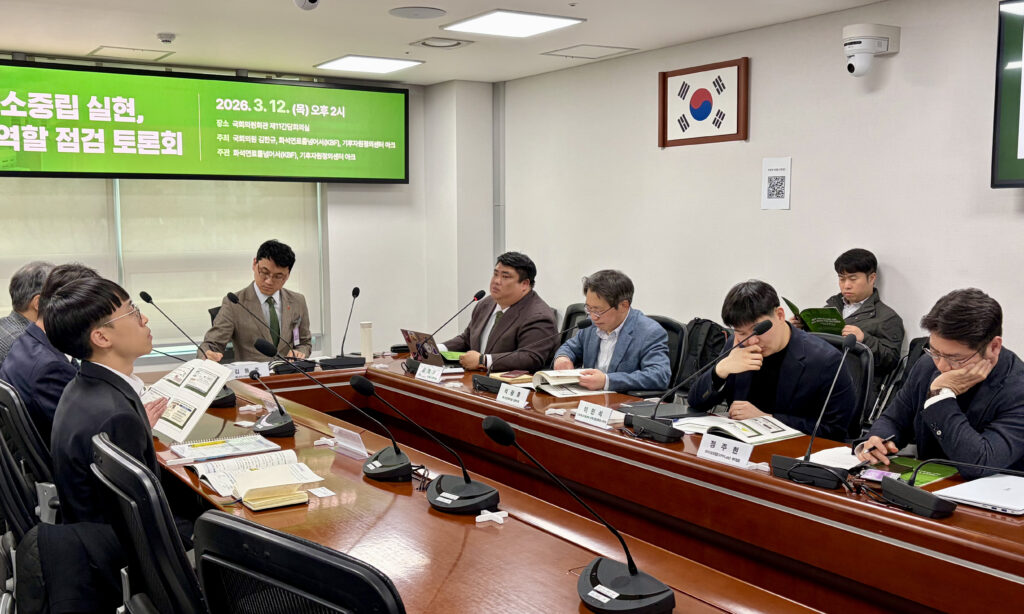
Experts Debate Technical Alternatives and Market Reform
During the panel discussion chaired by Kim Dong-joo (Secretary General of the Korea NGO’s Energy Network):
Joo Jae-sik, Director at Korea East-West Power, defended the project as a necessary bridge to replace aging, high-emission bio-heavy oil generators.
Tom Janghyeok Lim, Researcher at Solutions for Our Climate (SFOC), pointed out that adding a 300MW unit to a 1GW grid worsens stability and will lead to more frequent curtailment of renewable energy.
Seok Kwang-hoon, Specialist in Technology Policy at Energy Transition Forum, cited international cases like Ireland and the UK, suggesting that grid stability can be achieved through market reforms and V2G (Vehicle-to-Grid) technology rather than fossil fuel “must-run” units.
Jeong Ju-hyeon, Chief Marketing Officer and Co-founder at VPPlab, warned that designating a new gas plant as a “must-run” unit would stifle the entry of flexibility resource providers.
Lee Min-seok, Deputy Director at Ministry of Climate, Energy and Environment (MCEE), concluded by stating that while grid stability is a priority, the ministry will carefully review various opinions during the establishment of the 12th Basic Plan for Electricity Supply and Demand.
Representative Kim Han-kyu concluded, “To resolve curtailment and expand renewables, we need a transparent discussion on the role of gas power. I hope this forum serves as a starting point for public consensus on Jeju’s energy roadmap.”
The video recording of this forum is available on the Korea Beyond Fossil Fuels (KBF) YouTube channel.