
“Climate is the Key to the 2026 Jeju Election”
Jeju Citizens Propose ‘13 Key Climate Policies’
- 13 policies selected from 67 tasks across 6 sectors at the ‘2026 Climate Outlook Forum’
- Demands for major shifts: Scrapping the 2nd Airport, reforming bus systems, and GHG caps for large buildings
- Civil society to push candidates for the 9th local election to adopt these as official pledges
On February 27, the forum ‘2026 Climate Outlook and Strategy: Dialogue with Regions – Jeju’ was successfully held to diagnose the climate crisis and shape strategies for the upcoming June local election.
Co-hosted by Jeju Action for Nuclear-Free and Climate Crisis and the Local Energy Transition Institute (LETI), the forum aimed to safeguard citizens’ livelihoods by analyzing the climate status of Korea and Jeju. It served as a vital platform for deriving practical policies to transform the 9th local election into a “Climate Election.” A total of 87 residents participated, finalizing ‘13 Key Climate Policies’ through expert presentations and intensive workshops.
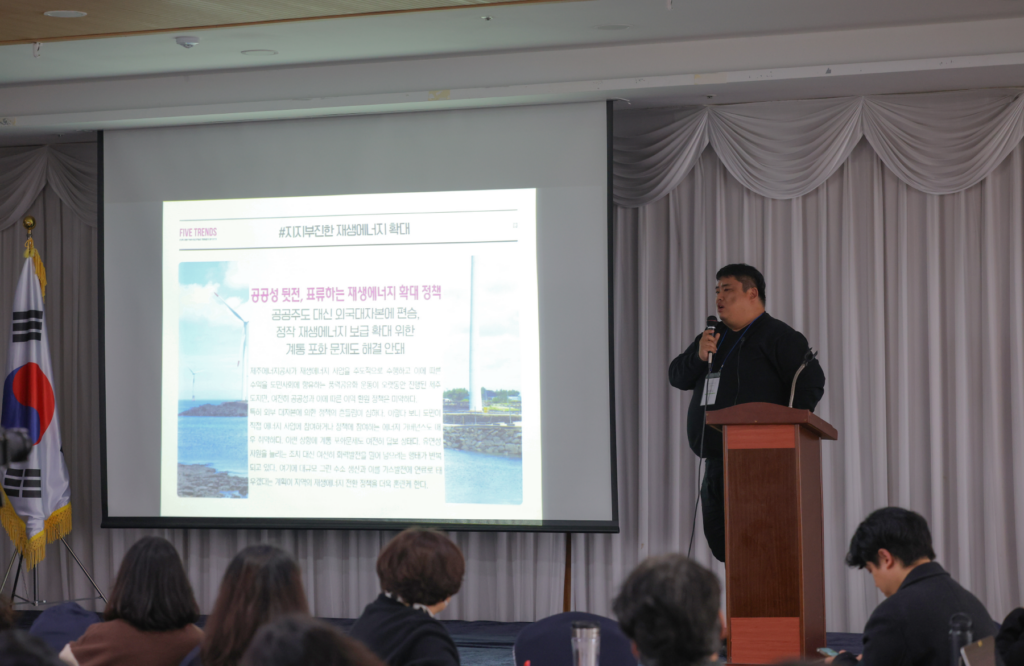
Prior to the workshop, Cho Chun-ho (former head of the National Institute of Meteorological Sciences) analyzed 2026 climate trends, and Ko Lee Ji-sun (LETI) presented institutional tasks for transition. Kim Jeong-do (Jeju Action for Nuclear-Free and Climate Crisis) highlighted policies running counter to carbon neutrality, such as the 2nd airport project and new gas power plants.
The selected 13 policies are tangible alternatives designed to resolve the climate anxiety residents face daily:
[Mobility] Transition to Pedestrian & Public Transit-Centered System This sector received the highest support. Residents demanded a halt to “climate-regressive” politics by scrapping the Jeju 2nd Airport project and modernizing the existing airport. They also called for expanding bus routes connecting villages to the city center and creating a “Pedestrian-First City” to reduce car dependency.
[Energy Transition] Ensuring Public Interest and Demand Management The forum reaffirmed the principle of public-led renewable energy and the return of profits to the community. A standout proposal was the preemptive GHG Cap for large buildings, reflecting the demand for high-responsibility from large-scale tourism facilities. Support for Carbon-Neutral Schools was also emphasized.
[Housing & Care] Resolving Climate Inequality To address unsold housing and aging homes, participants proposed converting vacant houses into public housing and expanding Green Remodeling for vulnerable groups. A “Climate Labor System” (incentives for companies) was also proposed to protect workers from extreme weather.
[Agriculture & Ecology] Local Circular Economy To protect primary industries, the forum proposed expanding local food markets, increasing Jeju-style Ecosystem Service Payments, and enacting ordinances for marine aquaculture waste management to link ecological value with green jobs.
Participants concluded that the voting results clearly revealed the deficiencies in Jeju’s current climate policies. They strongly agreed that a fundamental shift in policy direction is essential, as both the central and provincial governments are currently pursuing projects that run counter to climate crisis response efforts.

Kim Jung-do stated, “The 13 policies represent the ‘will of the people.’ We will demand all candidates for governor, superintendent, and councilors to adopt these as official pledges.”
Ko Lee Ji-sun of the IGT added, “The next administration’s term leads up to 2030, a critical milestone for Carbon Neutrality. This election carries immense responsibility for Jeju’s green transition.”
The organizers will now deliver a formal policy proposal to each political party to ensure these voices are reflected in the upcoming election.