
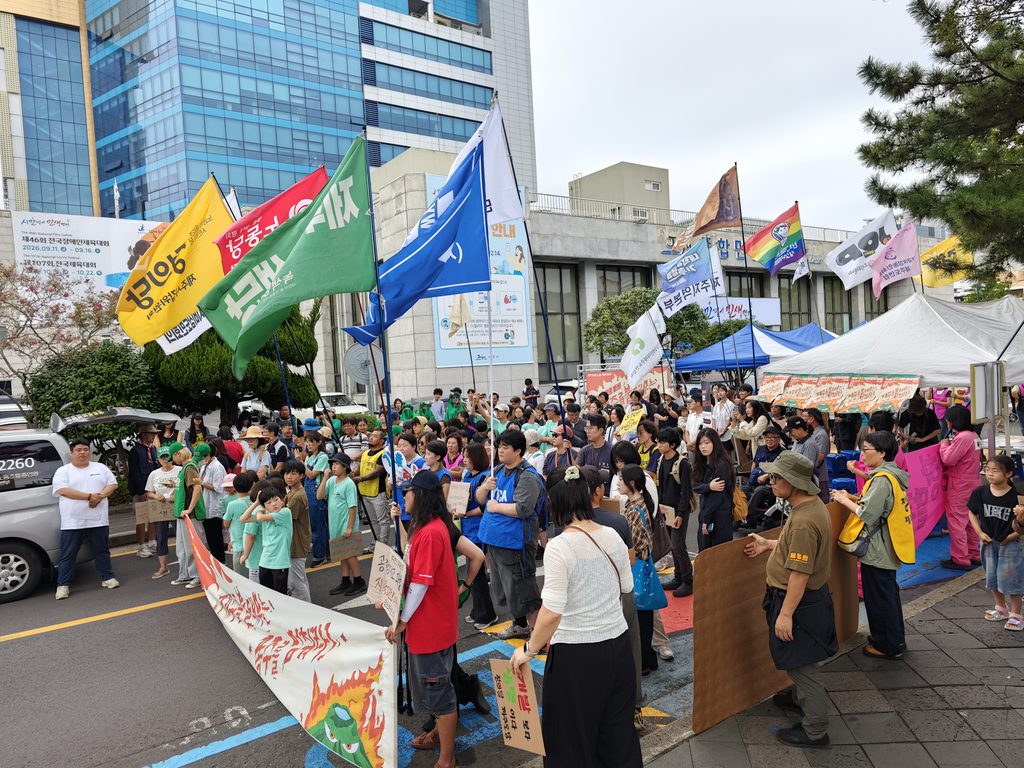
Participants preparing for the street march at the 2026 Jeju Climate Justice March ©ARC Center
On September 19, with the shock of Nepal’s unprecedented floods still fresh in people’s minds, the 2026 Jeju Climate Justice March took place around Jeju City Hall. As the climate crisis increasingly manifests itself not as a distant prediction but as an everyday disaster—through heatwaves, droughts, torrential rain, rising sea temperatures, and damage to agriculture and fisheries—people in Jeju once again took to the streets. Around 300 citizens, workers, farmers, young people, and civil society activists gathered to raise their voices under the call: “Beyond the era of climate disaster, toward an era of climate justice.”
The Jeju Climate Justice March has been held annually since 2022. It began from the recognition that simply joining large-scale climate marches in Seoul and other cities was not enough to fully convey the specific challenges facing Jeju. As an island, Jeju is directly experiencing climate impacts such as rising sea temperatures, changing conditions for agriculture and fisheries, drought, and water scarcity, while at the same time confronting major development issues including the proposed second airport, new gas-fired power generation, tourism development, and transportation infrastructure. Now in its fifth year, the march was organized not only to raise awareness of the climate crisis, but also to provide a space where citizens themselves could voice what needs to change in Jeju.
The event began at 1 p.m. on the road opposite the General Civil Affairs Office of Jeju City Hall. Before the main street march at 3 p.m., a total of 18 booths run by local civil society organizations lined the street. Participants moved between them, learning about issues involving the environment, labor, agriculture, and energy while taking in the lively atmosphere of the event.
One of the busiest spaces was the flea market booth. Items collected and donated little by little by participants sold rapidly throughout the afternoon. From dinosaur toys to a carefully stored bottle of whisky, the range of items was as varied as the people who had brought them. For a moment, the scene was lively enough to make one forget that this was a climate march and not a neighborhood market.
The other booths had their own distinctive character. Quiz-based activities were particularly noticeable. At the booth run by the Jeju Regional Headquarters of the Korean Confederation of Trade Unions, participants were invited to answer questions about large-scale “mega-projects.” The Jeju Green Party, meanwhile, set up a quiz asking which types of buildings had the highest carbon emissions and energy consumption. The serious expressions on the children’s faces as they tried to work out which buildings consumed the most energy were especially memorable.
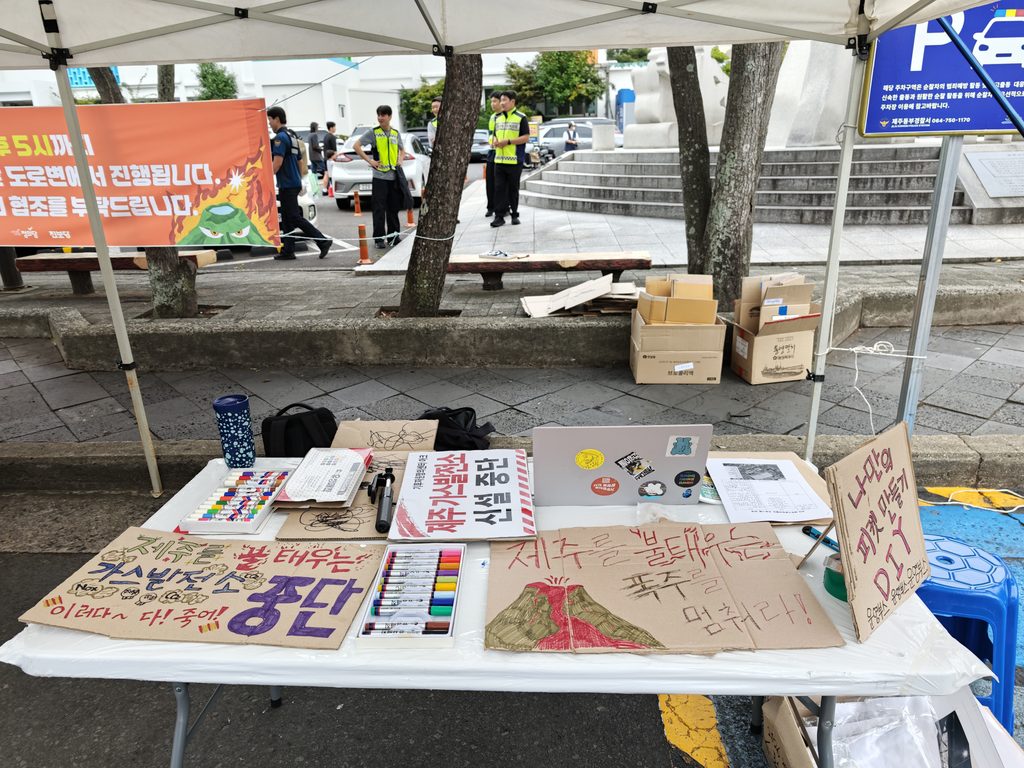
Various protest placards displayed at a booth ©ARC Center
Participants gathered in small groups throughout the venue, many holding handmade placards carrying messages of their own. Their words reflected very different concerns. For some, the climate crisis was a question of the energy transition and an ethical commitment to respecting life. For others, it was about agriculture and livelihoods. For still others, it was about the kind of future society we are choosing to create and the fate of generations yet to come.
Even when confronting the same climate crisis, people experience its impacts in different ways. Yet those differences only made the meaning of climate justice clearer. Climate impacts do not fall equally on everyone, and the costs and sacrifices associated with responding to them can likewise become concentrated among particular communities and regions. The march therefore became a space where concerns scattered across different fields and communities could be brought together.
The key demands of this year’s Jeju Climate Justice March emerged from precisely this understanding. The organizing committee called for the cancellation of the Jeju Second Airport project, an end to factory farming, the expansion and stronger management of marine protected areas, a halt to indiscriminate road construction, and increased public spending on public transportation, cycling, and walking infrastructure.
The organizers also demanded a halt to the construction of new gas-fired power plants, a comprehensive review of the proposed 40 MW AI data center, an expansion of ecological and environmentally sustainable agriculture to protect farmers’ rights and food sovereignty, and stronger development restrictions in Jeju’s mid-mountain areas to safeguard groundwater.
At first glance, these issues may appear unrelated. Airports, power plants, data centers, livestock farming, transportation, agriculture, the ocean, and groundwater all belong to different areas of public policy. But hearing the different voices gathered in one place made clear that they are not entirely separate. Underlying them all is the same question: What additional burdens will Jeju’s natural environment and local communities be asked to bear in the climate crisis, and who will ultimately be made to shoulder those burdens?
Ahead of the march, the organizing committee held a press conference on September 4 under the slogan, “Stop the reckless drive burning Jeju.” The message was clear: Jeju cannot continue to speak of responding to climate change while simultaneously pursuing projects that may increase greenhouse gas emissions and intensify development pressures. The voices heard on the streets that day likewise went beyond simply supporting or opposing individual projects. They called for a broader reconsideration of what kind of development and transition Jeju should pursue in an era of climate disaster.
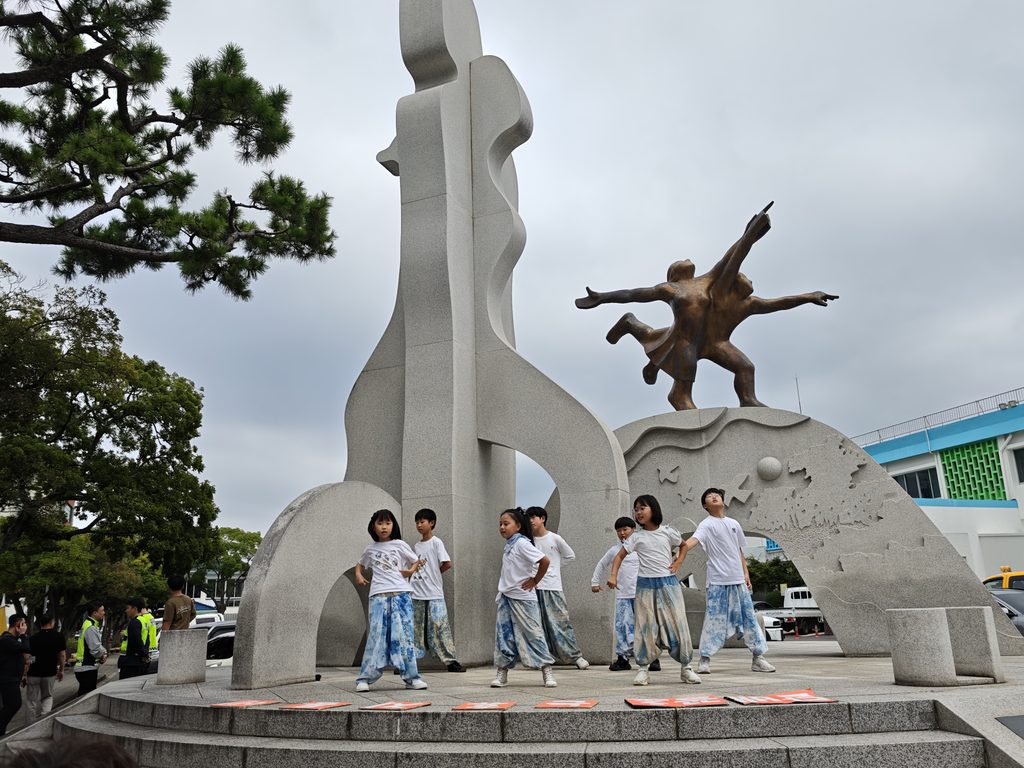
Performance by Jigubyul Kids ©ARC Center
After the booths closed, a pre-march program began at 2:30 p.m. with a performance by Jigubyul Kids. Following the approximately ten-minute performance in front of the Jeju City Hall sculpture, Jungdo Kim, Director of ARC Center, who served as the event’s emcee, briefly explained the purpose of the Jeju Climate Justice March. This was followed by speeches addressing a range of climate-related issues facing the island.
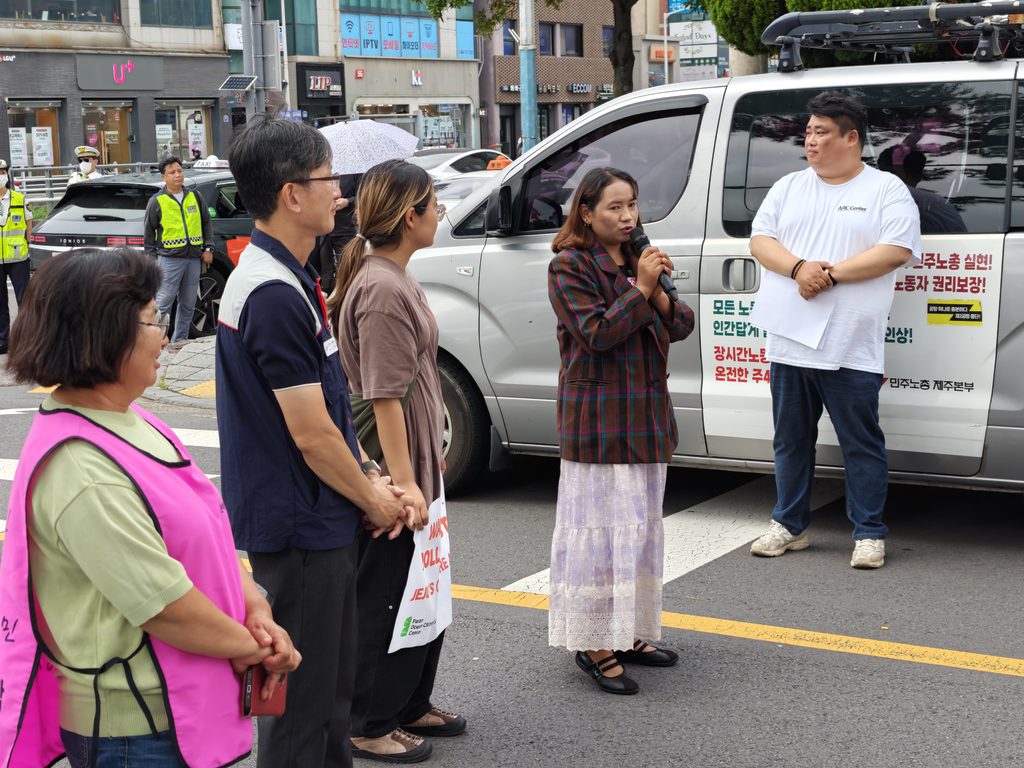
Participants delivering remarks during the pre-march program ©ARC Center
Four speakers took the stage: Kang Seung-hee of the Jeju Federation of the Korean Women Peasants Association, Im Gi-hwan, head of the Jeju Regional Headquarters of the Korean Confederation of Trade Unions(KCTU), Bu Mi-hye of the Paran Ocean Citizen Science Center, and Sunita Bulun, representing Jeju’s Nepali community.
Kang Seung-hee spoke about the reality facing farmers on the front lines of climate disaster. She described how farmers are now installing sprinklers and hoses and staying awake through the night to keep their fields watered, explaining that she had come to the march precisely to speak about life as a farmer already living at the forefront of the climate crisis. At the same time, she stressed that climate disaster does not affect farmers alone, but threatens workers and other people with less social and economic power as well. She asked why people in the Global South, rather than those in the countries historically responsible for the largest share of emissions, should bear the greater burden of climate damage, and pledged that women farmers would continue to stand in solidarity with the struggle for climate justice.
Im Gi-hwan of the Jeju Regional Headquarters of the KCTU opened his remarks with criticism of large-scale mega-projects. He argued that conglomerates and major corporations are granted various forms of preferential treatment while the resulting costs and harms are passed on to workers and ordinary people. He also criticized the proposed special legislation for mega-project zones, warning that exemptions from the 52-hour workweek could encourage longer working hours.
Large-scale data centers were another focus of his remarks. He pointed out that the enormous electricity, water, and infrastructure required to operate such facilities could ultimately place additional burdens on Jeju residents. He rejected development that hands over Jeju’s shared resources for the sake of corporate profits, stressing that Jeju’s land and resources are not commodities for a small number of capital interests but belong to the people who live and work on the island.
Bu Mi-hye of PARAN began by recalling her childhood growing up in Jeju and gathering bomal, a local type of sea snail, along the coast. Today, however, she said their numbers have visibly declined because of rising sea temperatures and marine pollution. She described the deterioration of Jeju’s marine environment, pointing to soft corals collapsing under high temperatures and low-salinity water, and Indo-Pacific bottlenose dolphins suffering after becoming entangled in fishing lines.
“What is the government doing to protect the ocean, which is on the front line of the climate crisis?” she asked. Declaring that “Jeju is most beautiful when it remains Jeju,” she called on both the national and provincial governments to prioritize conservation and the expansion of protected areas over further development.
The final speaker was Sunita Bulun, representing the Nepali community. Bulun, who said she had lived in Jeju for 13 years as a marriage migrant, spoke in a trembling voice about the devastation and suffering caused by the catastrophic floods in Nepal. At several moments, she struggled to continue and paused to regain her composure, conveying the depth of the pain and grief involved. She said that while she could not provide enough help to affected communities on her own, she hoped that each person could contribute even a little, and appealed for continued attention and support for recovery efforts. Her remarks were followed by prolonged applause.
A declaration was then read aloud by Kim Iee-su-an, a ninth-grade activist from Bomulseom School, and Choi Seul-gi, Eco-Conservation Bureau Director, Jeju KFEM. They read through the eight demands put forward to overcome climate disaster in Jeju. As they reached the final passage—pledging to stop a system in which the government and National Assembly appear more concerned about falling economic indicators than climate disaster, and in which climate crisis itself is turned into a new source of profit—the crowd responded with applause and cheers.
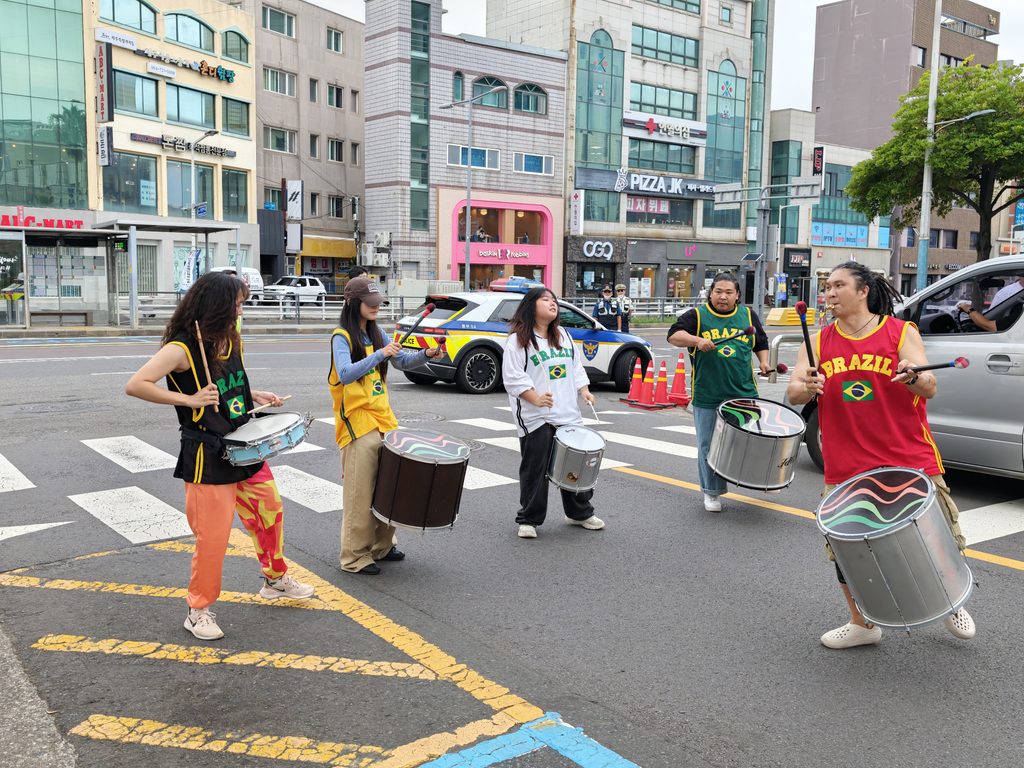
Batucada performance opening the march ©ARC Center
The reading of the declaration was followed by a batucada performance to open the march. The lively percussion filled the streets around City Hall, and participants responded with clapping and movement of their own. With the batucada group leading the way, hundreds of people departed from Jeju City Hall and began the march.
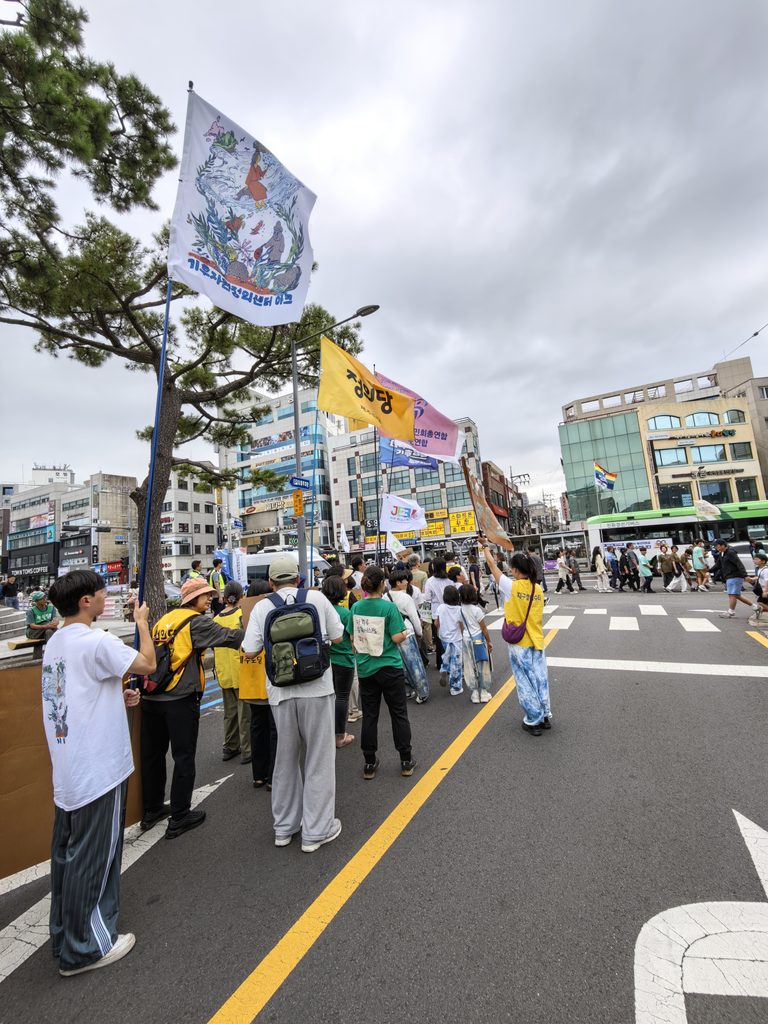
Participants taking part in the street march ©ARC Center
Holding placards and flags, participants chanted the eight demands as they moved from City Hall through Gwangyang Intersection, past the Lee Mi-ae Dermatology Clinic, and back toward City Hall. Roads normally dominated by cars were instead filled with people’s footsteps and voices. Rows of flags fluttering in the wind created a striking scene. Passersby and nearby shopkeepers stepped outside to watch the procession. When children in the march shouted the slogans at the top of their lungs, adult participants around them broke into broad smiles.
Near the end of the march, participants carried out a die-in performance. After returning to the area in front of City Hall, they lay down on the road together at the sound of a siren. A die-in is a form of protest that uses the human body to show that the climate crisis is not a distant environmental issue, but one that directly threatens the survival of humans and other living beings.
When the bustling procession suddenly stopped and people lay across the road, the street was transformed. Participants closed their eyes as they lay on the asphalt. For a brief moment, even the hectic rhythm of the city seemed to fall silent. When the siren ended, people slowly rose, straightened their clothes, and began moving again. Their faces carried different expressions, but each seemed marked by a renewed sense of resolve.
After returning to Jeju City Hall, participants concluded the day with closing remarks and one final round of the eight slogans.
We cannot accept climate disaster as an unavoidable fate. A single march cannot change everything. Yet when citizens demanding change gather in one place, listen to one another, and walk side by side, that act itself can become a starting point for change. May the steps taken from Jeju City Hall on September 19 not remain confined to a single day, but grow into a force capable of gradually changing the way Jeju responds to the climate crisis.