
By Ayu Kusuma Pertiwi, Policy Researcher, ARC Center
The massive fire crisis in Indonesia is exposing a vulnerability in the state’s approach to land governance. Efforts to reclaim forests and plantations through Forest Area Enforcement may strengthen state control over territory, but do not necessarily resolve the long standing ecological conditions that make these landscapes vulnerable to fire.
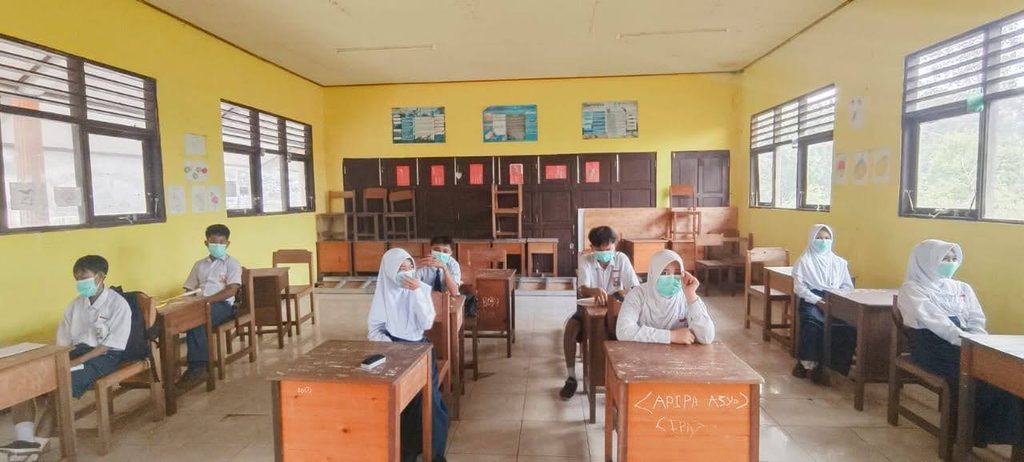
Students wear masks in the classroom as haze from forest and land fires affects air quality in Kanjarau Hamlet, Kapuas Region, Central Kalimantan. (Source: Syahri, 2026)
The Indonesian government has come under intense public scrutiny over the country’s land and forest fire crisis, particularly since August 2026. Yet the crisis had been unfolding since the beginning of the year, affecting approximately 202,010.96 hectares, more than three times the size of Seoul, from January to June across both forest and non forest areas. International attention grew as conditions worsened with the onset of the dry season. The Nusantara Atlas identified a cumulative 895,657 hectares of land burned across Indonesia by the end of August, affecting areas from Kalimantan, Sumatra, Sulawesi to Papua. South Papua province recorded the largest burned area, at 114,291 hectares, while West Kalimantan experienced a sharp increase with 53,893 hectares burned in August, bringing its cumulative total to 79,391 hectares.
| No. | Province | Burned Area (Hectares) |
| 1 | South Papua | 114,291 |
| 2 | East Nusa Tenggara | 91,120 |
| 3 | West Kalimantan | 79,391 |
| 4 | Central Kalimantan | 62,264 |
| 5 | South Kalimantan | 59,563 |
Table 1. Five Provinces with the Largest Cumulative Burned Areas, January – August 2026 (Source: Nusantara Atlas, September 2026).
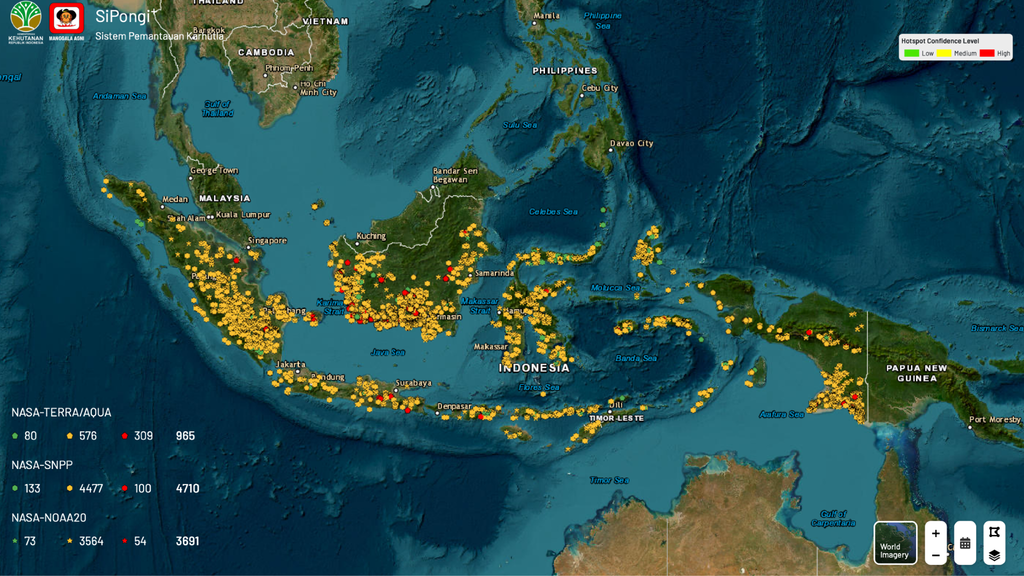
Picture 1. Hotspot map recorded by Indonesia’s Ministry of Forestry’s forest and land fire monitoring system on September 9, 2026.
Land and forest fires do not only degrade and destroy burned landscapes. The resulting haze affects multiple sectors, including public health, education, transportation, the economy, and public services. As of September 10, a cumulative total of at least 113,336 cases of acute respiratory infections were recorded by the Ministry of Health, of which 26,545 cases (23.4%) were among children aged 0-5 years. Schools were temporarily closed, while severe visibility problems disrupted transportation. Between August 22 and 25, for example, 43 flights from Soekarno-Hatta International Airport in Jakarta to Kalimantan were reportedly cancelled because of poor visibility. The severity of the fires was also evident in their transboundary impacts, with haze reported in Malaysia, Singapore, the Philippines, and Brunei.
The severity of the 2026 fires has been aggravated by increasing dry climatic conditions. In its atmospheric dynamics analysis published on August 24, the Indonesian Agency for Meteorology, Climatology and Geophysics (BMKG) reported that 90.29% of Indonesia was experiencing low rainfall and that 79.9% of the country had entered the dry season, while strengthening El Niño contributed to hotter and drier weather.
These climatic pressures interact with longstanding ecological vulnerabilities, in particular degraded and drained peatlands, wetlands in which partially decomposed plant material accumulates over time, forming thick, carbon rich soils that become highly flammable when dried. More than half of Indonesia’s peat forests in Kalimantan and Sumatra (52%) have already converted to other land covers from 1990 to 2015, including through the expansion of plantation and agricultural areas such as palm oil plantations. The 2026 crisis therefore cannot be understood solely as a consequence of extreme climate. It also reflects the persistent risks of Indonesia’s landscapes to fire resulting from long term land use change and ecological degradation.
The fire crisis is nothing new for Indonesia as other major fires previously occurred in 1997, 2015, and 2019, highlighting the recurring nature of the problem. Following the 2015 fires, the government introduced stronger restrictions on burning and peatland management and established the Peatland Restoration Agency (BRG), now the Peatland and Mangrove Restoration Agency (BRGM). The government’s zero-burning policy, particularly on peatlands, is backed by criminal sanctions, including imprisonment. The 2026 fires alone have already resulted in 138 named suspects, while eight corporations have reportedly been investigated. Reported motives include clearing forests for palm oil cultivation, illegal land transactions, and forest encroachment.
The government’s response to the 2026 fires has emphasized suppression, enforcement, and administrative coordination through deployment of additional TNI (Indonesian Armed Forces) personnel, water bombing helicopters, weather modification, coordination between central and regional agencies, and strengthened law enforcement. These measures are important for responding to immediate fire risks and addressing violations, but suggests that suppression and enforcement alone cannot resolve the landscape level ecological conditions that make parts of Indonesia vulnerable to recurring fires. The limitations of this approach become notably critical within the current regime of state territorialization, which has been marked by attempts to strengthen state authority over forest territory.
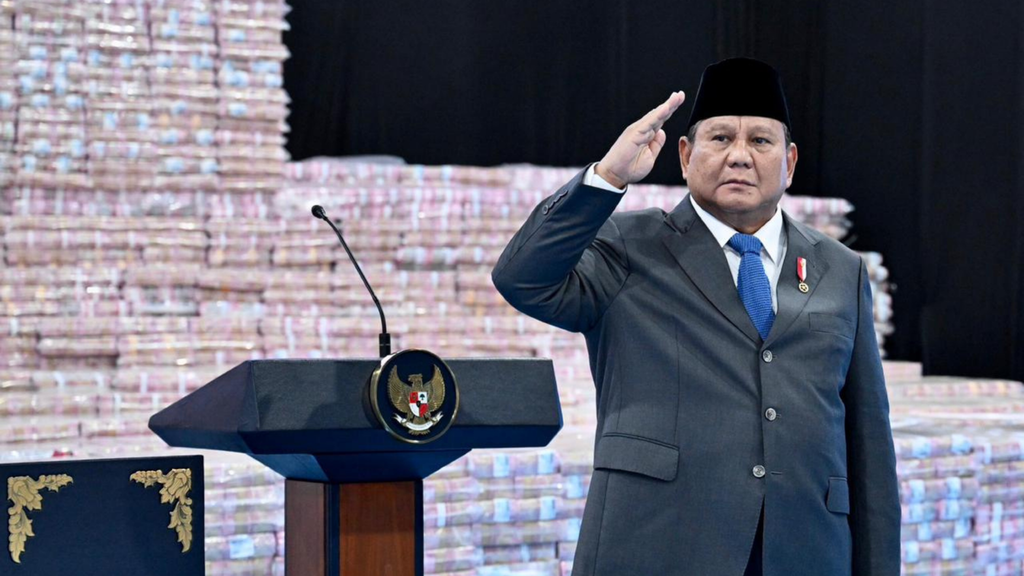
Picture 2. President Prabowo Subianto saluted the members of Satgas PKH at the Attorney General’s Office in Jakarta on Friday, April 10, 2026. (Source: Indonesian Cabinet Secretariat)
The current administration’s efforts to strengthen control over forest areas can be identified from a new mechanism for the resumption of state control through the Forest Area Enforcement (Penertiban Kawasan Hutan/PKH) policy implemented by Satgas PKH (Forest Area Enforcement Task Force). Established under Presidential Regulation (Perpres) No. 5 of 2025 on Forest Area Enforcement, Satgas PKH is a high level, cross sectoral government task force established directly under the President to accelerate the resolution of land governance issues and activities within forest areas, bringing together law enforcement, security and intelligence, financial, and natural resource authorities. The policy draws on the state’s authority over forests under the Forestry Law 1999 and embodies the constitutional principle of state control over natural resources. It provides mechanisms including administrative fines, repossession of forest areas, and asset recovery in response to activities such as mining, plantations, and other activities occurring improperly within forest areas.
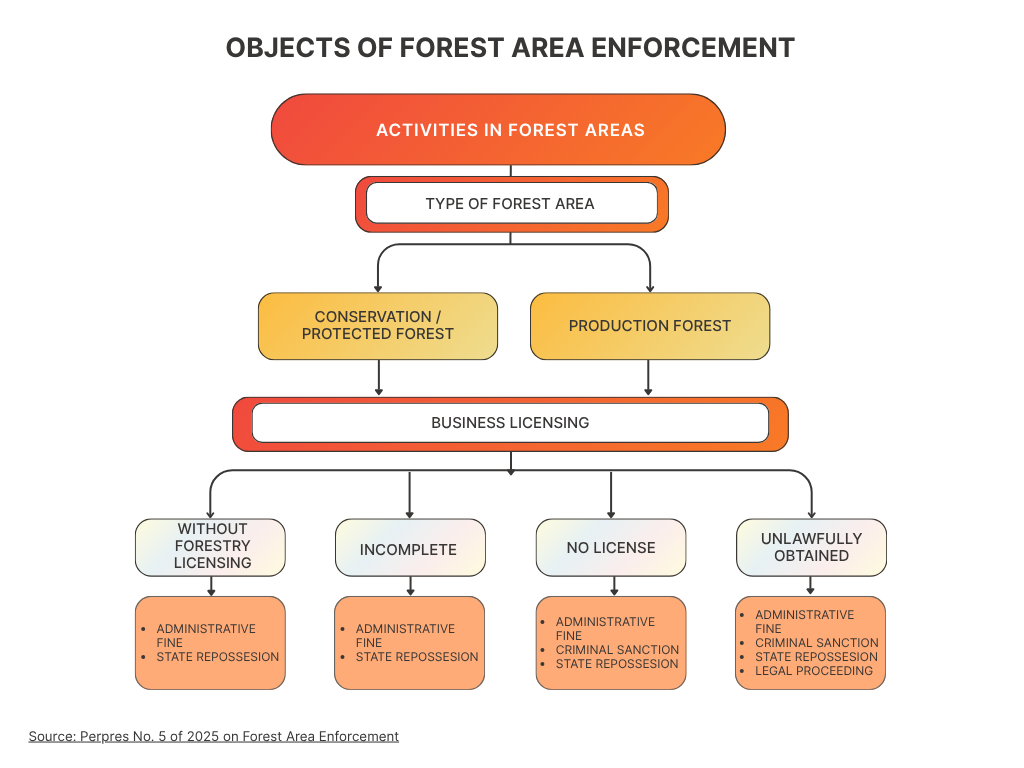
Flowchart 1. Categories of Activities Subject to Forest Area Enforcement.
The scale of this intervention is significant. On May 13, 2026, approximately three months before the intensification of the fires, the government marked the seventh stage handover of Satgas PKH’s achievements, reporting approximately IDR 10.27 trillion in state revenue. Since January 2025, Satgas PKH has cumulatively generated approximately IDR 41.57 trillion through state revenue and administrative fines, including penalties imposed on hundreds of corporations in the palm oil, mining, and forestry sectors. The government has also reported the instatement of 5,889,141.31 hectares within the palm oil plantation sector and 12,371.58 hectares within the mining sector.
| Period | Reported State Revenue (IDR) |
| October 2025 | 13.255 trillion |
| December 2025 | 6.625 trillion |
| April 2026 | 11.420 trillion |
| May 2026 | 10.270 trillion |
| Total | 41.57 trillion |
Table 2. State Revenue Reported by Satgas PKH, October 2025–May 2026.
Following the enforcement, approximately 900,000 hectares were transferred to the forestry sector and 4.11 million hectares to PT Agrinas Palma Nusantara, a state owned palm oil enterprise. From the perspective of state control, governance, and revenue generation, the recovery of these territories shows a major success of state authority over forest areas. However, territorial recovery does not determine how these territories will subsequently be governed or whether their management will address the ecological conditions that persist within them. The 2026 fire crisis shows a concrete example as fires occurred across different land use and legal statuses, including corporate concessions, private and Cultivation Rights areas, National Strategic Project sites, protected or conservation areas, and even areas previously repossessed by Satgas PKH.
One recent case is the burned peatland formerly associated with PT Kurnia Subur and subsequently managed by PT Agrinas in Sungai Guntung Hilir Village, Riau Province. On August 24, 2026, the fire was addressed jointly by the TNI, Manggala Agni (Forest and Land Fire Brigade), the Indragiri Hulu Regency Regional Disaster Management Agency, and other relevant stakeholders. It is significant because fire occurred on land subject to a recent change in governance illustrates the gap that can emerge between reinforcing control over territory and addressing the ecological conditions. This emphasizes the need for forestry governance to reconcile economic development with ecological sustainability and public welfare, because forests perform environmental, social, and economic functions, as recognized within Indonesia’s forestry framework.
Reclaiming forest areas and transferring them to new forms of management is proven does not necessarily resolve the environmental pressures associated with land conversion when the land is subsequently used for palm oil plantations, including forest land released through the PKH mechanism. Such a process may allow economically intensive land uses to continue or expand even after state control has been reinforced. These pressures are likely to become increasingly serious as demand grows for the state’s food and bioenergy program, mineral extraction such as nickel to support downstream industrialization, and the development of National Strategic Projects. Taken together, these competing demands may intensify competition for land and contribute to continued deforestation and ecological degradation.
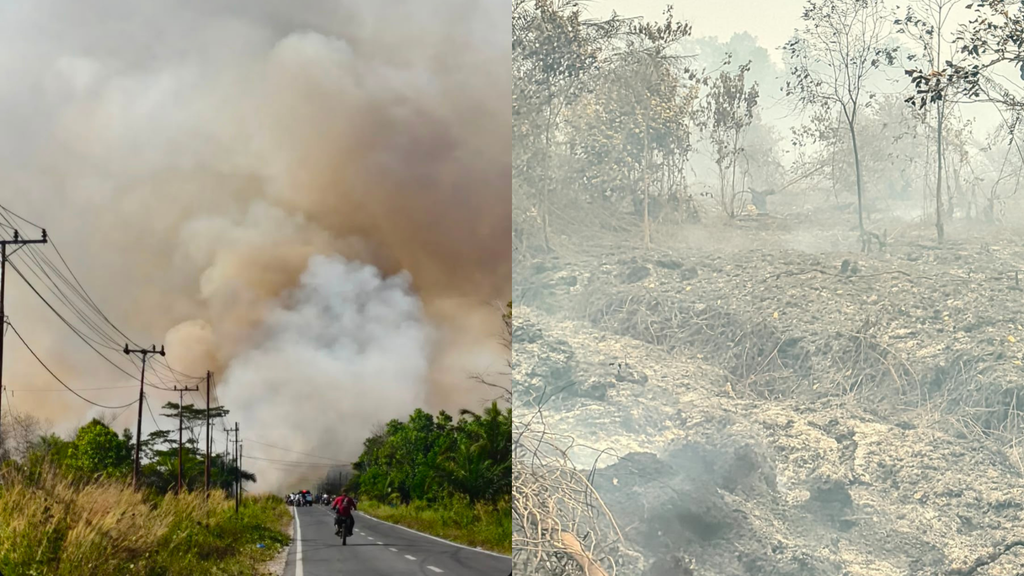
Picture 3. Land fire in Palangka Raya, Central Kalimantan, shown during the fire and after the area was burned (Source: Rohwilis and Chandra, 2026).
Amid the global environmental and climate crisis, addressing and resolving forest and land fires must extend beyond suppression and enforcement toward the restoration and protection of ecological functions, which means ensuring that policies that strengthen the state’s authority and capacity in land governance, such as PKH, also support reforestation and ecosystem recovery, hydrological restoration, biodiversity protection, peatland protection, and other measures that strengthen climate resilience, reduce the risk of recurring fires, and safeguards the public interests that make these territories valuable in the first place.