
By Shin Young Chung, Senior Researcher, ARC Center
The Emergence of the 20th-Century Alchemist
In the early 20th century, as the age of electricity began and demand for copper surged, the grade of copper ores in existing mines steadily declined. At the time, ore was considered worth mining only if it contained at least 5–10% copper. However, Daniel C. Jackling, an American mining engineer and metallurgist, devised a method to extract copper from soil containing as little as 2% copper. Instead of digging underground shafts, Jackling introduced a system in which massive steam shovels stripped entire mountainsides—moving tens of thousands of tons per day—transported the material by rail, and then extracted copper through chemical processing at centralized facilities. By deriving valuable minerals from common ore, Jackling can rightly be seen as a modern successor to the alchemists who once sought to turn base metals into gold.
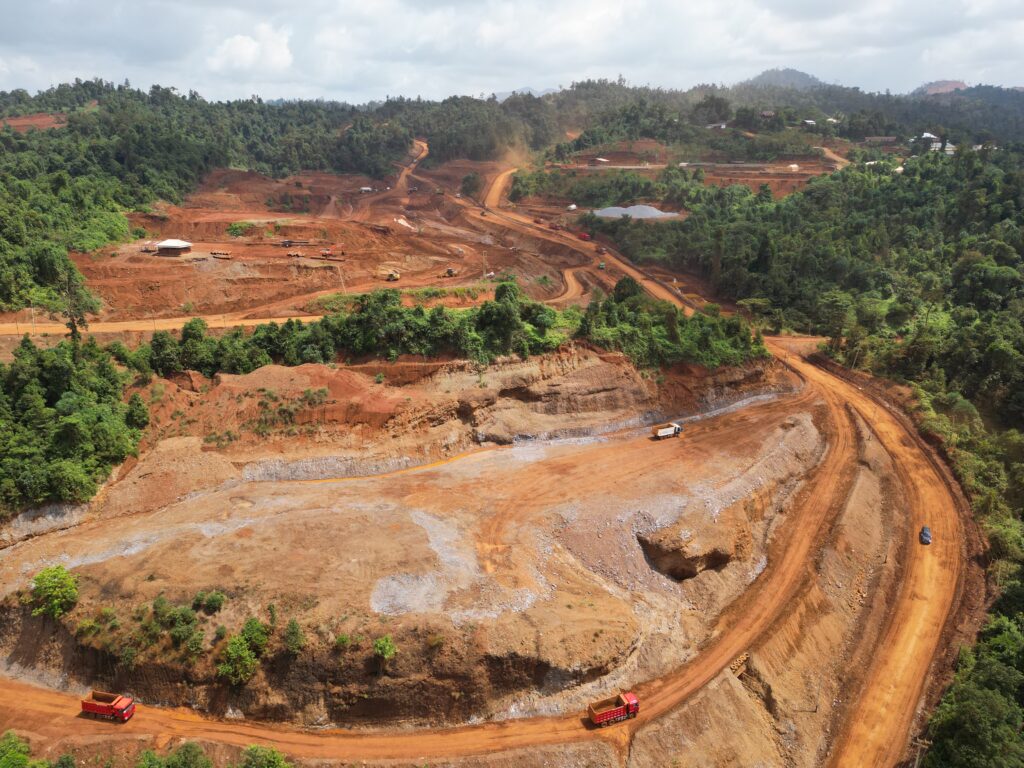
The Landscape of the Mine – Excavators and Dump Trucks
Since 2020, the transition from internal combustion engine vehicles to electric vehicles—justified as a response to the climate crisis—has driven a rapid increase in demand for minerals. In this process, Jackling’s “alchemy” continues to operate. Indonesia has become a major producer of nickel, a key material for improving battery energy density, accounting for approximately 67% of global nickel production as of 2025.
In Indonesia, nickel does not occur in underground veins but in laterite—iron-rich tropical soil spread widely across forest floors. As a result, mining is conducted through open-pit methods rather than underground tunneling. Laterite is divided into limonite, a reddish clay closer to the surface, and saprolite, a rocky soil layer beneath it. Limonite typically contains only around 1% nickel, while saprolite contains approximately 1.5–2.5%.
Because Indonesian nickel ore is low-grade, extracting nickel requires the removal of vast quantities of earth. After accounting for moisture removal and losses during smelting, one ton of saprolite yields roughly around 10 kg of nickel, while lower-grade limonite yields only about 6 kg. Considering that a mid-sized electric vehicle battery (NMC 811, around 60 kWh) requires over 40 kg of nickel, it becomes clear that several tons of earth must be excavated to produce a single vehicle. As a result, Indonesian open-pit mines resemble large-scale civil engineering sites, where excavators and dump trucks continuously dig and transport soil, rather than traditional mines with pickaxe-wielding workers.
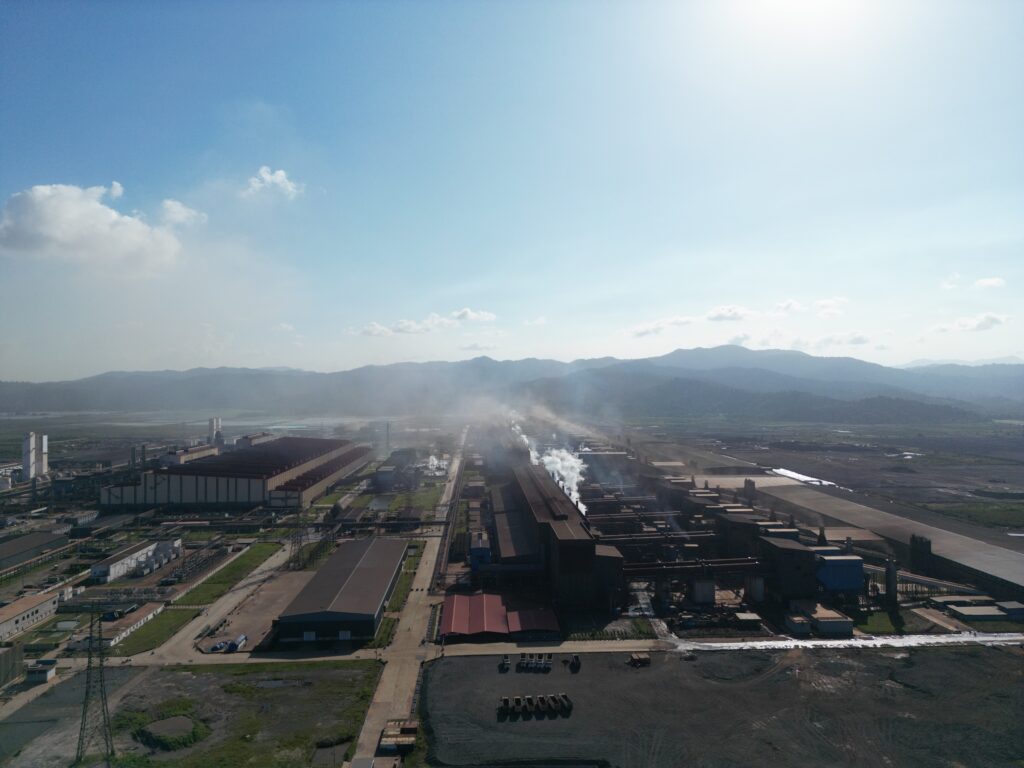
The Landscape of the Smelter – Coal Power Plants
The low-grade ore extracted from mines is transported to nearby industrial complexes, where it undergoes smelting to produce refined nickel products. Saprolite is processed in Rotary Kiln Electric Furnace (RKEF) facilities. After drying in a rotary kiln, the material is smelted in electric furnaces at temperatures exceeding 1,500°C, producing nickel pig iron (NPI) with a nickel content of 10–15%. While NPI is primarily used in stainless steel production, it can also be further processed in a matte converter with sulfur addition to produce high-grade nickel matte (over 70% nickel) for battery use.
Limonite, on the other hand, is processed through High-Pressure Acid Leach (HPAL), which uses sulfuric acid under high temperature and pressure to produce mixed hydroxide precipitate (MHP) or nickel sulfate—key materials for battery precursors.
The problem is that the enormous energy required for these processes is largely supplied by coal-fired power plants. In Indonesia’s Sulawesi and Maluku regions, where nickel mining is concentrated, captive coal power plants are rapidly expanding. As of July 2023, total installed capacity stood at 7.16 GW, but by July 2025 it had more than doubled to 15.4 GW. Including plants under construction, total capacity is projected to reach 18 GW—far exceeding Seoul’s peak electricity demand of approximately 9–10 GW.
The Village Sky – Polluted Air and Failing Health
Coal-fired power plants in nickel industrial complexes emit massive amounts of greenhouse gases. Dry smelting processes can generate approximately 58.09 tons of CO₂-equivalent emissions per ton of nickel produced, while HPAL produces about 5.40 tons per ton. Beyond power generation, air pollutants are emitted throughout the entire lifecycle—from mining and transportation to refining—severely degrading air quality in Sulawesi and Maluku.
According to Center for Research on Energy and Clean Air (CREA), projected emissions of nitrogen dioxide, sulfur dioxide, and particulate matter in these regions far exceed World Health Organization guidelines and Indonesian legal standards. Without intervention, air quality is expected to worsen further.
This pollution is already having serious impacts on local communities. Residents must clean black dust that accumulates inside their homes daily, while cases of respiratory and skin diseases are rapidly increasing. Local health centers report rising numbers of acute respiratory infections each year, alongside growing rates of malnutrition and stunted growth among children.
The Village Rivers and Seas – Mining Waste and Contaminated Water
Nickel industrial complexes also generate vast quantities of waste. HPAL facilities in particular produce large volumes of toxic waste due to their use of strong acids. For every ton of nickel produced through HPAL, approximately 133 tons of waste are generated—highly acidic and containing heavy metals.
Initially, companies sought to dispose of this waste through deep-sea tailings disposal, but the Indonesian government prohibited this practice, requiring land-based storage instead. In response, companies introduced dry stack tailings systems, which remove moisture before storage. While industry actors claim this method is safer than conventional tailings dams, experts warn that Indonesia’s frequent earthquakes and heavy rainfall make such facilities inherently risky.
These waste storage sites already threaten nearby communities and workers. There have been multiple reports of fatal accidents due to facility collapses, and even without collapse, toxic leakage has severely contaminated surrounding water sources. In one notable case, the Harita Group was found to have identified dangerous levels of carcinogenic hexavalent chromium through its own testing, yet continued expanding operations without addressing the issue. Residents can no longer use river water—now visibly reddish-brown—for drinking or daily use, and studies have confirmed the deterioration of local water quality.
Farewell to the Alchemist
Just as lead does not naturally turn into gold, soil does not magically become clean electric vehicles. The transformation of Indonesia’s red earth into nickel for EV batteries comes at the cost of destroying the lives of those who depend on that land. The persistence of alchemists in the past was not due to a lack of scientific knowledge, but rather the human desire for easy wealth. There has never been an easy way to produce gold, and there is none today.
Attempting to address the climate crisis by invoking a new form of alchemy—while preserving our own comfort and sacrificing the livelihoods of others—is a path bound to fail. What we need now is not an alchemy driven by desire, but a new way of living that reduces it. Only by choosing to live with less—more slowly, and less conveniently—can we finally free ourselves from the specter of the alchemy.