Controversy arises as Jeju pushes for a large-scale 300MW gas plant, contradicting its “2035 Carbon Neutral” declaration.
Growing calls to replace gas plants with flexibility resources such as BESS and grid improvements to solve curtailment issues.
Concerns over annual losses of 67 billion KRW in Jeju’s agriculture and fisheries if climate response fails; National Assembly seminar to review energy policy.
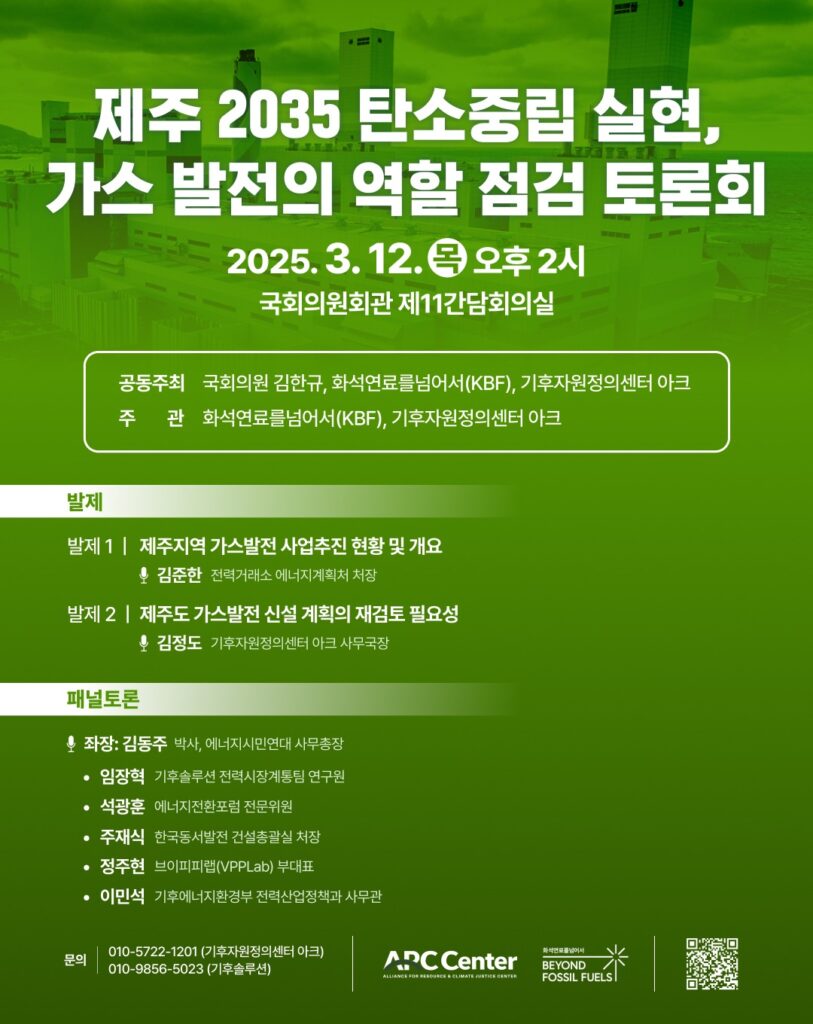
- Date & Time: Thursday, March 12, 2026 | 14:00 – 16:00
Venue: Room 11, Members’ Office Building, National Assembly
Co-hosted by: National Assembly Member Kim Han-kyu, Korea Beyond Fossil Fuels, Alliance for Resource & Climate Justice Center
| 14:00~14:10 | Opening Remarks | Kim Han-kyu, Member of the National Assembly (Video) |
| 14:10~14:30 | Session 1: Current Status of Gas Power Projects in Jeju | Kim Jun-han, Director of Energy Planning, Korea Power Exchange (KPX) |
| 14:30~14:50 | Session 2: Necessity of Re-evaluating Jeju’s Gas Plant Plans | Kim Jung-do, Director, Alliance for Resource & Climate Justice Center |
| 14:50~15:40 | Panel Discussion Moderator: Kim Dong-joo, Secretary General, Korea NGO’s Energy Network | Panelists: Tom Janghyeok Lim, Researcher Solutions for Our Climate(SFOC) / Seok Kwang-hoon, Specialist in Technology Policy, Energy Transition Forum / Joo Jae-sik, Director, Korea East-West Power / Jeong Ju-hyeon, Chief Marketing Officer and Co-founder, VPPLAB / Lee Min-seok, Deputy Director, Electric Power Industry Policy Division(MCEE) |
| 15:40~16:00 | Q&A and Closing |
On March 12, National Assembly Member Kim Han-kyu, Beyond Fossil Fuels, and the Climate and Resource Justice Center ARC will host a seminar to evaluate the role of gas power in achieving Jeju’s 2035 Carbon Neutrality.
Jeju is a frontrunner in carbon neutrality, with renewable energy accounting for 52% of its total capacity. However, the inclusion of a new 300MW gas power plant in the 10th and 11th Basic Plans for Electricity Supply and Demand has sparked criticism for directly contradicting the province’s 2035 vision. Research indicates that failing to respond adequately to the climate crisis could result in an annual loss of 67 billion KRW in value-added revenue for Jeju’s agriculture and fisheries, highlighting the urgency of ending fossil fuel dependency.
Currently, Jeju faces severe “curtailment” issues, where renewable energy generation (such as wind power) is restricted due to surplus power. While power authorities argue that new gas plants are essential for grid stability, critics suggest that alternatives—such as the completion of the Wando-East Jeju #3 HVDC link and the operation of large-scale Battery Energy Storage Systems (BESS)—are sufficient to provide the necessary flexibility.
This seminar will explore the necessity of shifting the new gas plant plans into projects focused on grid flexibility and technology demonstration within the upcoming 12th Basic Plan for Electricity Supply and Demand. The goal is to fundamentally resolve the curtailment of renewable energy and establish Jeju as a “testbed” for innovative energy industries through sound policy alternatives.