
By Hyelyn Kim, Executive Director, ARC Center
Ebola is spreading at an alarming pace in the Democratic Republic of the Congo (DRC). By the end of August 2026, the number of confirmed cases had surpassed 6,000, with nearly 3,000 deaths—the highest death toll from an Ebola outbreak ever recorded in the country. Ituri Province in northeastern DRC, where the outbreak began, has long been affected by armed conflict and is also one of the country’s major mining regions. One factor making the Ebola response particularly difficult is the high mobility of mine workers. Artisanal miners move from one mining site to another in search of work. In some cases, health authorities lost track of miners who had been identified as contacts after they moved on to other mining sites. Conflict, poverty, and the lack of alternative livelihoods make it difficult for people to leave the mines even amid the threat of a deadly disease.
Poverty is not the only force that keeps drawing people into the mines. There is also a geopolitical reality in which the strategic value of minerals has never been higher. Minerals have emerged as strategic resources that shape national economies and security, while competition over supply chains—particularly between the United States and China—has intensified. The DRC sits at the center of this competition for an obvious reason: it is rich in gold, copper, cobalt, coltan, and other minerals that underpin modern industry, advanced technologies, and energy systems. In 2025, the DRC accounted for around 73% of global mined cobalt production. That same year, global cobalt demand reached 276,000 tonnes, up 13% from the previous year, driven largely by growing battery demand for electric vehicles and portable electronics. Demand from the defense and aerospace sectors also increased.
When we hear the word “mine,” it is easy to picture a modern open-pit operation, with enormous machinery moving earth and rock. Yet alongside these industrial mines, the DRC is also home to artisanal and small-scale mining, where people dig into the earth by hand with little more than picks and shovels. Siddharth Kara, who has spent more than two decades researching modern slavery and forced labor, described the shock of his first visit to the DRC’s cobalt mines as having “hit me like a thunderclap.” The miners he witnessed dug tunnels by hand to depths of 30 to 50 meters, often without proper structural supports or ventilation.
Children were present at most of the mines he visited. Some boys descended into narrow tunnels to extract ore, while women and girls washed ore by hand in contaminated water. After working all day, miners could earn as little as one or two dollars. The tunnels, dug deep underground with few safety measures, frequently collapsed, sometimes burying those working inside. Kara called this place “the bottom of trillion-dollar supply chains.” Follow the long supply chains of sleek smartphones and laptops, batteries and cars all the way to their source, and at the very bottom lies a brutal landscape of human labor.
Over the past decade or so, however, a new justification has been added to the expansion of mining. Ironically, it is the climate crisis. The International Energy Agency (IEA), the World Bank, and others have projected that vast quantities of minerals will be needed to expand electric vehicles and batteries, solar and wind power, and electricity grids. Mining companies have been quick to embrace this shift in narrative. Global mining giant Rio Tinto points to population growth, economic development, and the energy transition as drivers of rising mineral demand, emphasizing that “the world needs mining.” In the first half of 2026, Rio Tinto’s consolidated sales revenue increased by 15% year-on-year, underlying EBITDA by 28%, and net earnings by 47%. Many factors shape corporate performance, but there is little doubt that its business is booming.
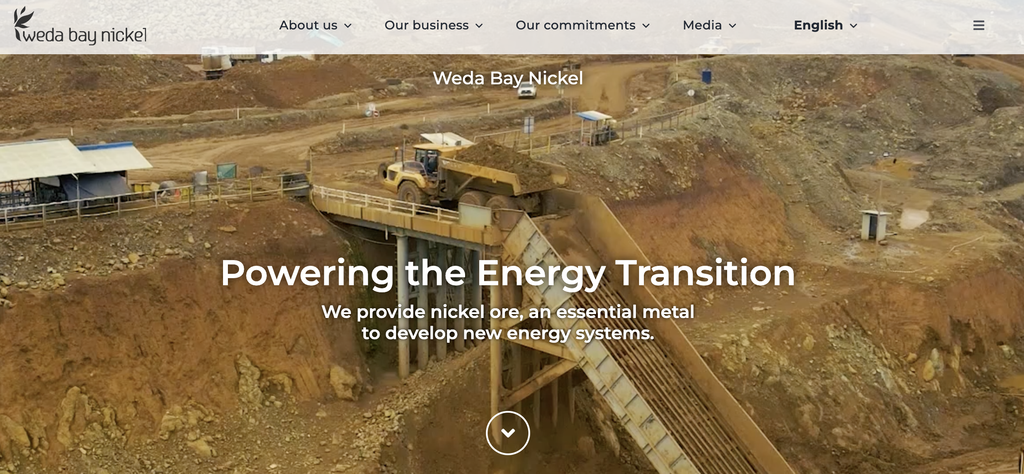
A similar narrative can easily be found in Indonesia’s nickel industry. Weda Bay Nickel, which operates a large-scale open-pit nickel mine in Halmahera, North Maluku, greets visitors to its website with the slogan “Powering the Energy Transition,” describing its nickel as essential to building new energy systems. The Indonesia Morowali Industrial Park (IMIP), one of the world’s largest nickel-processing industrial complexes, has also established a cluster for producing EV battery materials, which it describes as supporting the government’s clean and renewable energy policies.
Yet Indonesia’s nickel industry remains far more closely tied to stainless steel production. According to an analysis published this April by the Centre for Research on Energy and Clean Air (CREA), around 83% of Indonesia’s nickel production in 2025 went to the stainless steel sector, while only 17% went into the EV battery supply chain. Indonesia’s nickel-processing infrastructure has also historically developed around RKEF smelters producing nickel pig iron (NPI), a key feedstock for stainless steel. Production of battery materials is expanding rapidly, but the current structure of Indonesia’s nickel boom remains centered on stainless steel.
So how much of the projected demand for minerals is actually tied to the energy transition? In July, the US-based independent research organization Oakland Institute reclassified IEA data on six major minerals—copper, cobalt, lithium, nickel, graphite, and rare earth elements—according to their end uses. Aggregating 2024 demand by weight, it found that solar and wind power, renewable electricity grids, and battery storage together accounted for about 21%, while EVs accounted for another 5%. The remaining 74% came from other industries, including construction, manufacturing, and industrial machinery.
A similar pattern emerges in projections for 2050. Under the IEA’s Net Zero Emissions (NZE) scenario, total demand for these six minerals rises to around 68 million tonnes. Yet according to the Oakland Institute’s analysis, EVs and non-clean-energy uses together account for between 66% and 100% of projected demand, depending on the mineral. By contrast, minerals directly required for renewable energy such as wind and solar represent a relatively limited share of projected overall demand. The report particularly highlights the enormous mineral demand created by a scenario in which today’s car-dependent transport system is simply replaced with electric vehicles. It cites research showing that smaller vehicles and batteries, combined with expanded public transportation and recycling, could reduce US lithium demand in 2050 by as much as 92% compared with the most mineral-intensive scenario.
There is a significant gap between acknowledging that minerals are necessary to tackle the climate crisis and claiming that all of the mineral demand currently projected is unavoidable for climate action. IEA data show that in 2024, around 83% of nickel demand and 71% of copper demand came from uses outside clean energy technologies. Future mineral demand is not a fixed constant either. It can change substantially depending on where we set our priorities and how we choose to use these resources.
Yet while mineral demand expands under the banner of climate action, a far more brutal reality persists in the countries where those minerals are extracted. In the DRC, which produces most of the world’s cobalt, only around 22.5% of the population had access to electricity in 2024. In the same year, an estimated 73.5% of the population lived in extreme poverty on less than $2.15 a day. As the world demands ever more minerals for electric vehicles, AI and data centers, electricity grids, and other industries, most people in the countries digging those minerals out of the ground still lack even the electricity to turn on the lights in their own homes.
Among the people Kara met was a boy who entered the mines to support his family after his father was injured while working there. The boy was later caught in a tunnel collapse that left him paralyzed from the waist down. Near the end of the interview, his father asked Kara, “Now you understand how people like us work?” As Kara began to say that he understood the horrific conditions in which they worked, the father cut him off.
“No. We work in our graves.”
This article was originally published in Pressian on September 5, 2026.